Associated periodontics refers to periodontal care that is coordinated with other dental specialties and whole‑mouth treatment plans. It matters because healthy gums and supporting bone affect not only your mouth but can influence overall health. This guide explains what associated periodontics covers, what a periodontist does, common treatments, and practical next steps you can take.
Read on to learn how associated periodontics in Bellmore, NY evaluates gum disease, treats implant problems, restores lost bone, and works with other dentists to protect your smile and health.
What Is Associated Periodontics?
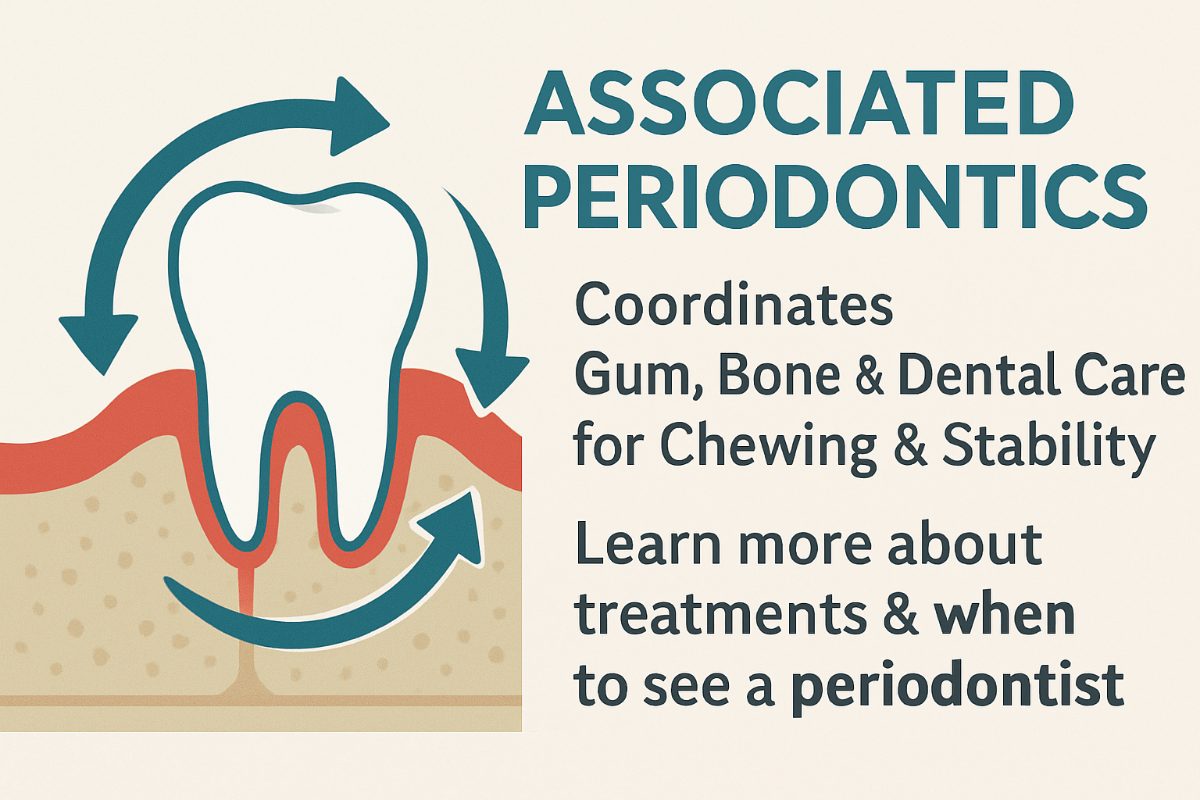
Associated periodontics combines traditional periodontal care—focused on gums, periodontal ligament, and jawbone—with coordinated treatment planning alongside other dental specialists. That means a periodontist treats gum and bone problems while working with general dentists, prosthodontists, and orthodontists to deliver a full‑mouth solution. In short, associated periodontics looks beyond isolated gums to restore structure, function, and long‑term health.
Common Conditions Managed by Associated Periodontics
Gum disease (gingivitis and periodontitis)
Periodontists diagnose gingivitis and periodontitis by measuring pocket depths, checking for bleeding, and using X‑rays to track bone loss. Associated periodontics monitors progression, controls infection, and aims to stop bone loss before it affects tooth support.
Gum recession and root exposure
Recession can come from brushing too hard, thin gum tissue, orthodontic movement, or past periodontal disease. Periodontists treat sensitivity and improve appearance with gum grafts, connective tissue grafts, or minimally invasive techniques to cover exposed roots and protect teeth.
Peri‑implant disease
Peri‑implant mucositis (inflammation) and peri‑implantitis (inflammation with bone loss) threaten dental implants. Associated periodontics in Bellmore, NY uses cleaning protocols, local antibiotics, laser therapy, and surgical care when needed to stop infection and preserve implant stability.
Bone loss and ridge defects
Bone defects change how teeth look and function and can prevent implant placement. Periodontists assess bone with 3D imaging and offer bone grafting, ridge augmentation, or guided bone regeneration to rebuild structure for function and future restorations.
Key Treatments in Associated Periodontics
Non‑surgical care
Initial care often includes scaling and root planing (deep cleaning), targeted antibiotic therapy, and laser treatments to reduce bacteria and inflammation. These steps can reverse early disease and prepare tissues for more advanced procedures if needed.
Surgical procedures
When non‑surgical care isn’t enough, surgical options include pocket reduction surgery, gum grafting to restore tissue, crown lengthening for restorative needs, and ridge augmentation to correct defects. Surgery aims to reestablish healthy anatomy and long‑term stability.
Implant surgery and restoration planning
Associated periodontics covers implant placement, bone grafting when needed, and coordination with restorative dentists for final crowns or bridges. Careful planning with 3D imaging ensures implants are placed for function, aesthetics, and longevity.
Maintenance and prevention
Long‑term success depends on maintenance: regular periodontal cleanings, targeted hygiene training, and routine monitoring to catch recurrence early. Associated periodontics emphasizes a schedule tailored to each patient’s risk.
When Your Dentist Will Refer You to Associated Periodontics
- Persistent deep pockets or bleeding after treatment
- Rapid or ongoing bone loss on X‑rays
- Failed or failing dental implants
- Need for complex implant or esthetic planning
- Advanced grafting required before restorations
What to Expect at Your First Periodontist Visit
Your initial exam for associated periodontics in Bellmore, NY typically includes periodontal charting, probing pocket depths, and 3D imaging to view bone and implant sites. The periodontist will review your medical history, explain the diagnosis, and show images so you understand the problem.
You’ll receive a personalized treatment plan with options, a timeline, and recovery expectations. The plan will outline non‑surgical care, possible surgeries, and follow‑up maintenance to protect results.
How Associated Periodontics Works With Other Dental Specialists
Teamwork improves outcomes. Examples include coordinating with a general dentist for crowns and bridges after grafting, working with an orthodontist to align teeth before gum surgery, and partnering with a prosthodontist for full‑mouth reconstructions. Integrated planning reduces surprises and improves long‑term function and esthetics.
Questions to Ask Your Periodontist
- What is my diagnosis and how does associated periodontics fit into my overall dental plan?
- What are the treatment options and alternatives?
- What are the risks, benefits, and success rates for each option?
- What recovery should I expect and how long will it take?
- How will this affect future implants, crowns, or braces?
- What are the costs and maintenance needed to prevent recurrence?
Why Choose Now Dental for Associated Periodontics
Now Dental provides comprehensive associated periodontics in Bellmore, NY under the care of Dr. Mitchell A. Kaufman, a board‑certified periodontist with decades of experience. The practice uses same‑day implant systems, advanced 3D imaging, lasers, and digital workflows to plan and deliver predictable results for periodontal and implant care.
Next Steps: Scheduling a Consultation
If you’re concerned about gum disease, bone loss, or implant health, schedule an evaluation to discuss associated periodontics in Bellmore, NY. A periodontist can explain options, create a personalized plan, and help protect your oral and whole‑body health.